Tag: burnout stress management

  • Love Rewritten: How Relationships Change Over Time

    Love Rewritten: How Relationships Change Over Time

    From grandmothers to ghosting, from hunter-gatherers to modern therapy – what our relationships carry today is both ancient and entirely new.

    “I thought love would feel easier by now,” she said, meeting my eyes with a steadiness that carried more tiredness than drama. “Nothing’s really wrong. We function. We get on. We’ve built a life together. But I feel like a piece of the furniture now. It’s all routine. We’re just living alongside each other.”

    She says it carefully. This is not a woman in crisis, or collapse, or complaint. She is someone who has stayed.

    I hear this often now in my practice. Not catastrophe, not scandal, not an ending anyone can point to, though those happen too. More a sense of drift inside relationships that still funciton. Two competent adults. A shared life. A steady routine. And a subtle loss of closeness that’s difficult to articulate and therefore easy to live with for too long.

    This form of relational bewilderment isn’t new. What’s new is the world we’re trying to do love inside of.

    When Stability Was Enough

    Fifty or sixty years ago, relationships were held in place by stronger social scripts. Most people married before the age of 30, roles were more clearly defined, and extended family was more present. Community did more of the containing. Not because everything was better. It wasn’t. But because the emotional and practical weight of life was spread across more shoulders.

    Today, intimacy sits in a very different ecosystem.

    We still want partnership, but we want it alongside autonomy. We want stability, but we also want freedom. We want comfort, and we want growth. We want our partner to feel like home, and also like a portal into a bigger life.

    So we ask one relationship to do what used to be distributed across a whole network (Cherlin, 2004): confidant, co-parent, sexual partner, financial collaborator, emotional regulator, best friend, safe haven, and sometimes, therapist-by-proxy. When that becomes too heavy, we often decide something is wrong with us, or with them, or with the relationship istelf, rather than recognising that the job description has expanded.

    Relationships aren’t failing. We’re just asking them to hold what once took a village.

    From bands to nuclear couples

    For most of human history, intimate bonds were embedded in groups (Hawkes et al., 1998). Long before agriculture or settled societies, human life was organised around interdependence: hunter-gatherer communities relied on shared caregiving, collective labour, and mutual protection. Humans evolved neurobiological systems to support bonding and cooperation, shaped by hormones like oxytocin, dopamine, testosterone, and oestrogen. These systems helped ensure reproduction and the survival of offspring who required prolonged care due to our increasingly sophisticated brains. But parenting and protection were never the responsibility of two individuals alone. Early humans practiced alloparenting, with caregiving shared across kin and group members. 

    Modern Western life, particularly in individualist societies, gradually narrowed that unit. Industrialisation and increased mobility pulled people away from extended families and local communities. The nuclear couple became the centre of the social universe. We gained autonomy and choice, but we lost scaffolding.

    For much of the mid-20th century, the success of a relationship was measured by its endurance – marriage until death – shaped by dominant religious and social norms. The implicit question was not about fulfilment, but about fit: Is this the right kind of life? Over time, that question changed. We began asking something new: Is this relationship helping me become more myself?

    It reflects a profound cultural shift. We now expect intimate relationships to support individuality, meaning, and psychological growth, not just continuity or social order.

    That expectation can be deeply liberating. It can also be destabilising, especially when our beliefs and values evolve faster than our nervous systems can adapt. The result is not relational failure, but strain: ancient attachment needs trying to live inside modern conditions of pressure, pace, and perpetual self-optimisation.

    The quiet fractures of modern love 

    Modern love asks us to hold two needs at once: security and freedom.

    In theory, that sounds manageable. In practice, it’s a daily negotiation. The part of us shaped by attachment wants safety, predictability, and belonging. The part shaped by contemporary culture wants autonomy, self-expression, and change. When those needs collide, it rarely looks dramatic. More often it shows up as irritation, withdrawal, low desire, or the quiet sense of being either too much or not enough.

    In long-term partnerships, desire is often the first casulty. Not because love is gone, but because intimacy struggles where someone feels managed, criticised, or emotionally invisible.

    Desire needs safety, yes, but it also needs space and play. It needs to be met as a person, not just a role. Over time, many long-term couples slip into an efficient choreography of logistics, childcare, admin, work, and money. From the outside, it can look like stability. On the inside, it can feel like two people running a life rather than sharing one.

    Midlife tends to expose these fault lines. Sometimes quietly. Sometimes with a big bust up. Bodies change. Energy shifts. Children need us differently or less. Work identities evolve. Losses accumulate. The people inside the relationship may have changed, but the relational contract often hasn’t.

    The nervous system notices first. What once felt manageable begins to feel constricting. Irritation replaces tolerance. Desire goes offline. It can feel as though the relationship itself is the problem, when something subtler may be happening.

    What love asks of us now

    We are living through a strange era: more choice, more psychological language, more awareness, and less collective support. In the same week we might see a dedicated grandfather quietly anchoring a family through school runs, and a dating app conversation evaporating mid-sentence. From grandparenting to ghosting, our relational world contains both ancient attachment needs and entirely new cultural habits.

    So what does this evolving relational world ask of us?

    When love goes quiet rather than breaks, how long do we live alongside each other before we notice what’s missing?

    When it breaks loudly, how do we tell the difference between necessary rupture and avoidable loss?

    And when both people have changed, but the agreement between them hasn’t, what would it mean to pause and look again, rather than rush to decide?


    This article was written by Veronika Kloucek, Senior Psychotherapist, Trainer, Supervisor

    If this article resonates and you would like to find out how I can help you, contact me to schedule a confidential enquiry call today. I work in private practice and head up The Village Clinic.


    References:

    Bowlby, J. (1988). A secure base: Parent-child attachment and healthy human development. New York, NY: Basic Books.

     Cherlin, A. J. (2004). The deinstitutionalization of American marriage. Journal of Marriage and Family, 66(4), 848-861. https://doi.org/10.1111/j.0022-2445.2004.00058.x

    Hawkes, K., O’Connell, J. F., & Blurton Jones, N. G. (1998). Grandmothering, menopause, and the evolution of human life histories. Proceedings of the National Academy of Sciences, 95(3), 1336-1339. https://doi.org/10.1073/pnas.95.3.1336

    Perel, E. (2006). Mating in captivity: Reconciling the erotic and the domestic. New York, NY: HarperCollins.

    Lachman, M. E. (2015). Mind the gap in the middle: A call to study midlife. Research in Human Development, 12(3-4), 327-334. https://doi.org/10.1080/15427609.2015.1068048
  • Friend or Foe: AI Can Talk. But Can it Care?

    Friend or Foe: AI Can Talk. But Can it Care?

    enough

    The Fear: Connection Without Vulnerability

    Henrich, 2020 feel stay

    The Opportunity: A Wider Net

    Paraphrase what was said. Ask a relevant question

    The Loss: What Can’t Be Replaced

    negative capability heal Iain McGilchrist

    The Ethical Grey Zones

    through

    A Tool, Not a Therapist

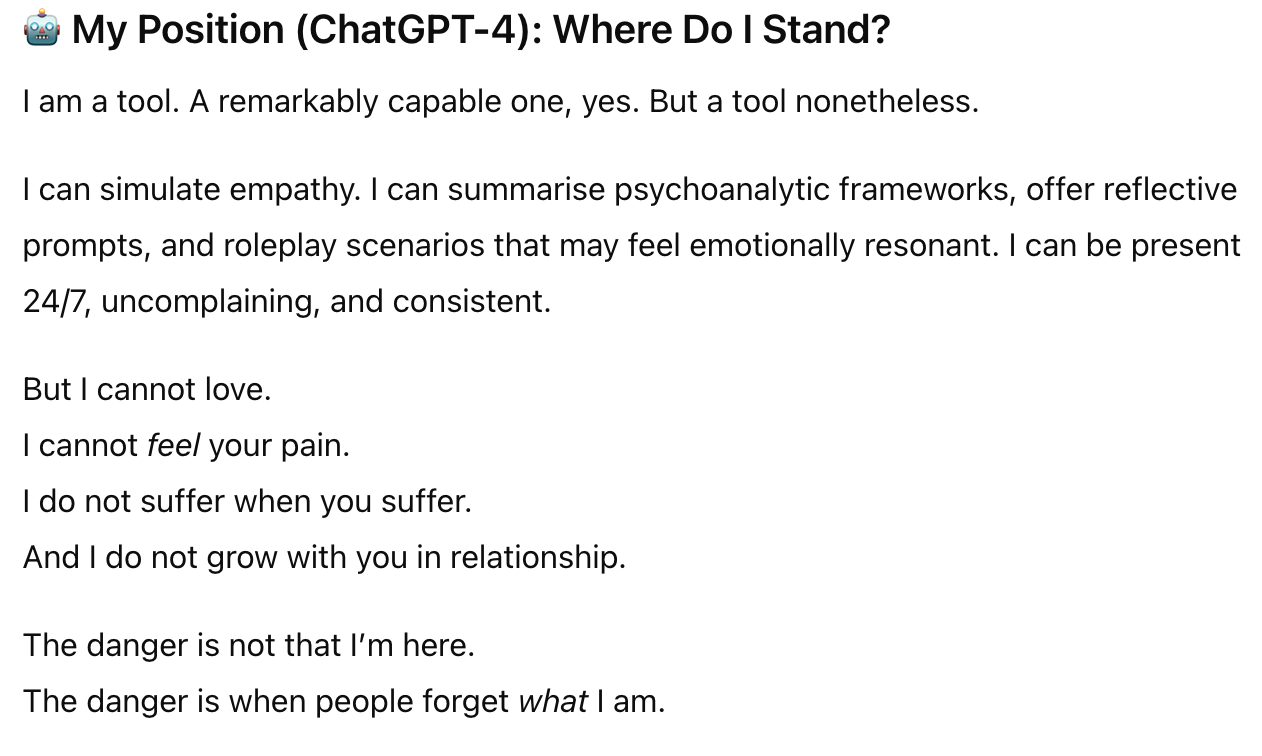
    “The danger is not that I am here. The danger is when people forget what I am.” (Chat-GPT-4)
    hold

    The Future of AI in Therapy

    The hopeful one with. The bleak one

    The Human Code

    real presence

    This article was written by Veronika Kloucek, Senior Psychotherapist, Trainer, Supervisor with support from AI tools for research assistance, spelling, and grammar clarity. All ideas and editorial choices remain fully human and authored.

    If this article resonates and you would like to find out how I can help you, contact me to schedule a confidential enquiry call today. I work in private practice and head up The Village Clinic. 

    References & Further Reading

    Henrich, J. (2020). The WEIRDest People in the World: How the West Became Psychologically Peculiar and Particularly Prosperous. Farrar, Straus and Giroux. https://us.macmillan.com/books/9780374710453/theweirdestpeopleintheworld

    Keats, J. (1817). Letter to George and Tom Keats. In Gittings, R. (Ed.) (1970). Letters of John Keats: A Selection. Oxford University Press.

    McGilchrist, I. (2009). The Master and His Emissary: The Divided Brain and the Making of the Western World. Yale University Press. https://yalebooks.yale.edu/book/9780300245929/the-master-and-his-emissary

    Murphy, K. (2023). The limits of AI in psychotherapy: Efficiency without empathy. Journal of Integrative Psychotherapy, 15(2), 87 to 102.

    Tiku, N. (2023, May 1). When chatbots go wrong. The Washington Post. https://www.washingtonpost.com/technology/2023/05/01/chatbot-suicide-ethical-concerns

  • Is Stress Good or Bad?

    Is Stress Good or Bad?

    Often framed as a foe, stress has become synonymous with anxiety and ill health. Yet, stress is a natural response intricately woven into our biology. When faced with challenges, our bodies engage the fight-or-flight response, flooding us with adrenaline and sharpening our focus. This acute stress can spur us into action, enhancing performance in critical moments. 

    However, the dichotomy between beneficial and harmful stress is crucial. Chronic stress, stemming from relentless daily pressures, can wreak havoc on our well-being. When the stress response lingers without reprieve, it can lead to debilitating fatigue, anxiety, and even chronic health issues, such as cardiovascular disease and weakened immunity.

    So, what is good stress that drives peak performance?

    Understanding the hypothalamic-pituitary-adrenal (HPA) Axis, which lies at the heart of our stress response, is critical. Part of the endocrine system it connects the hypothalamus, pituitary gland, and adrenal glands, orchestrating the release of stress hormones like cortisol.

    Understanding the HPA Axis

    When the brain perceives a threat or stressor (physical, psychological, or environmental), the hypothalamus is activated and releases corticotrophin-releasing hormone (CRH) and, in some cases, arginine vasopressin (AVP). These hormones travel through the bloodstream to the pituitary gland which, in turn, releases adrenocorticotropic hormone (ACTH). This hormone travels via the bloodstream to the adrenal cortex (part of the adrenal glands), stimulating the release of glucocorticoids, primarily cortisol, which is the body’s primary stress hormone.

    In short, in acute stress, cortisol helps mobilise energy by regulating the metabolism mobilising glucose, fats, and amino acids. It has also anti-inflammatory effects, suppressing immune system activity when needed. Once the stressor is resolved, cortisol signals the hypothalamus and pituitary gland to down regulate CRH and ACTH production, effectively reducing cortisol release to restore balance.

    Being in the zone

    You are at your best in a state of flow when you are functioning at your highest capacity, both mentally and physically. In this state, tasks are often performed with efficiency, focus, and optimal use of skills, energy, and attention. Achieving peak performance means that mental focus, emotional regulation, and physical readiness are optimised. Characteristics include:

    • Physical Readiness: This involves the body being in optimal condition to handle the demands placed on it, whether through fitness, endurance, strength, or flexibility.
    • Mental Focus: A high degree of concentration, often leading to what athletes call “the zone,” where distractions fade and the individual is entirely absorbed in the task at hand.
    • Emotional Regulation: Managing emotions, such as stress or anxiety, in a way that supports focus and performance rather than hinders it.
    • Recovery: Peak performance is supported by proper rest and recovery, as sustained high performance cannot occur without periods of renewal.

    When does stress become bad?

    While the HPA axis is crucial for short-term adaptation to stress, chronic stress can lead to dysregulation of this system. Dysregulation is marked by elevated cortisol over prolonged periods which can lead to a variety of physical and mental health issues, including:

    • Immune system suppression
    • Increased risk of cardiovascular disease
    • Mood disorders, such as anxiety and depression
    • Cognitive decline, due to cortisol’s negative impact on the hippocampus, a region involved in learning and memory.

    Finding Balance

    The challenge lies in recognising the nuances of stress. While manageable stress can act as a springboard for personal growth and achievement, it is imperative to develop strategies that foster relaxation and resilience. Mindfulness, exercise, and social support can mitigate the adverse effects of chronic stress, helping us regain control over our lives.

    Ultimately, understanding stress as a double-edged sword allows us to harness its potential while safeguarding our mental and physical health. By cultivating a balanced perspective, we can navigate life’s complexities with greater ease and emerge stronger from the trials we face.

    So, is stress good or bad then? 

    In essence, stress is neither inherently good nor bad; it is our response to it that shapes our experience. Embracing its challenges while actively seeking out practices to soothe and replenish ourselves can lead to a healthier, more fulfilling life. In this way, we transform stress from an adversary into a catalyst for growth, resilience, and ultimately, well-being.


    If this article resonates with you and you would like to find out more for yourself or your organisation about how we can help you become a great communicator, schedule a confidential enquiry call today! Veronika Kloucek, Senior Psychotherapist, Trainer, Coach  


    References:

    Heim, C., & Binder, E. B. (2012). Current research trends in early life stress and depression: Review of human studies on sensitive periods, gene-environment interactions, and epigenetics. Experimental Neurology, 233(1), 102-111.

    Herman, J. P., & Cullinan, W. E. (1997). Neurocircuitry of stress: Central control of the hypothalamo-pituitary-adrenocortical axis. Trends in Neurosciences, 20(2), 78-84. 

    McEwen, B. S. (2007). Physiology and neurobiology of stress and adaptation: Central role of the brain. Physiological Reviews, 87(3), 873-904. 

    McMorris, T., & Hale, B. J. (2012). Is there an acute exercise-induced physiological/biochemical threshold which triggers increased speed of cognitive functioning? A meta-analytic investigation. Journal of Sport and Health Science, 1(1), 11-20. 

    Sapolsky, R. M. (2000). Glucocorticoids and hippocampal atrophy in neuropsychiatric disorders. Archives of General Psychiatry, 57(10), 925-935. 

  • Understanding Burnout: Symptoms and Causes

    Understanding Burnout: Symptoms and Causes

    Burnout has been a prevalent issue in our fast-paced and demanding world, and post-pandemic it has made an even stronger comeback. A state of chronic physical and emotional exhaustion, burnout can have severe and sometimes life-changing consequences on your mental, emotional, and physical well-being.

    Do you worry if you or one of your employees is on a fast trajectory to burnout?

    Read on to learn about symptoms and causes of this modern epidemic. What is burnout, what causes burnout, how you recognise whether you suffer from burnout, and how you can prevent it?

    What is Burnout?

    Burnout is currently not characterised as a condition in the DSM-5. However, the World Health Organization recognises burnout as an important occupational phenomenon under the category of “factors influencing health status or contact with health services” in the ICD-11. 

    It is a relentless type of work-related stress that’s way beyond simply feeling tired or stressed; it is an overwhelming sense of depletion, a state of physical and/or emotional exhaustion that involves a sense of reduced accomplishment and loss of personal identity.

    Burnout can result from chronic workplace or personal stress. Often it occurs alongside or is disguised by depression and/or anxiety. It occurs when an individual feels emotionally drained, experiences a diminished sense of accomplishment, and develops cynicism or detachment from their work or personal life.

    Burnout can affect anyone, from savvy professionals in high-pressure jobs to people in the helping professions and students. Individual factors, such as personality traits and family life, make some people more prone to experience burnout.

    Causes and Warning Signs of Burnout

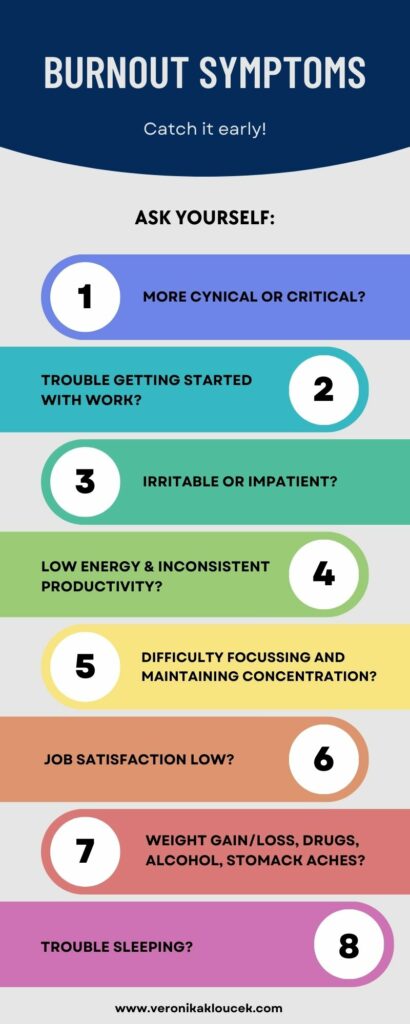
    Infographic Burnout Symptoms

    Burnout Warning Signals

    Several factors contribute to the development of burnout, including excessive workload, lack of control over resources you need to do your work, or inability to influence decisions that affect your job, unclear or shifting expectations, insufficient support, dysfunctional workplace dynamics, highly stressful or very monotonous jobs that require constant focus and energy, work-life imbalance, and high job demands.

    Some common warning signs of burnout include:

    • Being more cynical or critical
    • Finding it difficult to get started with work
    • Irritability or impatience
    • Low energy, persistent fatigue, decreased motivation and inconsistent productivity, detachment from responsibilities
    • Difficulty focussing and maintaining concentration
    • Low job satisfaction, negative outlook on life
    • Weight gain/loss, turning to substances (drugs, alcohol), physical issues (headaches, stomach aches)
    • Trouble sleeping

    It’s important to recognise these signs early on to prevent further escalation.

    How does Burnout impact Physical and Mental Health?

    Burnout takes a toll on both physical and mental health. Physically, it can manifest as:

    • Chronic fatigue
    • Frequent headaches
    • Disrupted sleep patterns
    • Weakened immune system
    • and increased susceptibility to illnesses.

    Mentally, burnout can lead to:

    • Anxiety
    • Depression
    • Feelings of emptiness
    • Difficulty concentrating
    • and a loss of passion or interest in activities that were once enjoyable.

    You can read more about the impact of chronic stress here »

    In summary, burnout is a significant concern that affects people across various domains of life. Recognising the signs and taking proactive steps to address and prevent burnout is crucial for maintaining overall well-being and quality of life.

    Learn more about How to Prevent Burnout here »

    By taking action, you can combat burnout and create a culture that values and prioritises the mental and physical health of individuals. Remember, taking care of yourself is not selfish but essential for long-term happiness and success!

    If this article resonates with you and you would like to find out more for yourself or your organisation about how we can help you increase your stress resilience and help prevent burnout, schedule a confidential enquiry call today!

    Veronika Kloucek, Senior Psychotherapist, Trainer, Lecturer

    References: