Tag: Therapy

  • Still Functioning, Totally Fried: The Slow Burn of Burnout

    Still Functioning, Totally Fried: The Slow Burn of Burnout

    You might recognise it. You keep going, keep doing, but something inside feels frayed. You’re not sleepy. You’re lost. You’ve tried to rest, but the rest doesn’t rest you.

    This is often the point where people land in my therapy room – burnt out, not just by work, but by long-standing pressure, perfectionism, invisible emotional labour. Burnout doesn’t always scream. It whispers: You’re not yourself anymore.

    When Rest Isn’t Enough

    Burnout is often mistaken for stress. But unlike stress, it doesn’t resolve with a weekend off or more sleep. It’s deeper. More existential. It affects your ability to feel joy, make decisions, or stay connected to what matters.

    According to the World Health Organization, burnout is a state of emotional, physical, and mental exhaustion resulting from prolonged stress, particularly in work or caregiving roles. But clinically, I see it in people across all contexts: parents, professionals, perfectionists, healers.

    Burnout hides in silence, until your mind keeps going, but your heart quietly leaves the room.

    Burnout Is a Disconnect, Not a Weakness

    Burnout often shows up as:

    • A sense of numbness or detachment
    • A creeping cynicism or self-blame
    • Emotional sensitivity, or total emotional shutdown
    • The quiet panic of being ‘on’ all the time, even while you rest

    These aren’t failures of character. They’re signals – indicators of a profound disconnect between your inner needs and outer demands.

    Why Digital Tools Only Go So Far

    Apps can remind you to breathe. Self-help books can inspire reflection. But when burnout is rooted in relational history, shame, identity, or chronic invisibility, these tools often hit a wall.

    Q: Why choose human-to-human therapy over AI or digital tools?
    A: AI and digital support can be helpful in a coaching-like way, but many clients find that deeper issues require a real relationship to be fully understood and worked through.

    The Power of Being Seen

    I work with many people who’ve tried everything before arriving in therapy, sleep trackers, coaching apps, nutrition plans. What made the difference wasn’t a new tool. It was the experience of being seen. Not scanned, not fixed, just met.

    Human-to-human therapy offers what burnout erodes: safety, empathy, reflection, relationship. It allows us to turn toward what’s underneath: unmet needs, self-neglect, perfectionism, inherited pressure.

    Therapy doesn’t fix you. It lets you rest long enough to hear what your burnout has been trying to say all along.

    How to Begin Again

    Burnout recovery isn’t instant. It’s slow, relational, and layered. But it is possible. You might begin by:

    • Naming what you’ve been pushing through
    • Noticing when you feel most emotionally absent
    • Allowing yourself to reach out before it gets worse
    • Exploring, in therapy, what parts of you have been quietly carrying too much for too long

    You don’t have to do this alone.

    And if You’re Still Not Sure

    If you’re reading this and feeling the quiet sting of disconnection – the doubt, the ache, the wondering if it’s even possible to feel like yourself again – know this: you’re not alone. That hollow space inside you isn’t a failure. It’s a sign of how much you’ve been carrying. 

    Therapy can be one place to begin again. A relationship where you don’t have to perform, explain, or hold it all together. Just space to be – tired, uncertain, human. And from that space, gently, something begins to shift. Something starts to feel possible again.


    This article was written by Veronika Kloucek, Senior Psychotherapist, Trainer, Supervisor  with support from AI tools for spelling and grammar clarity. All ideas and editorial choices remain fully human and authored. If this article resonates and you would like to find out how I can help you, contact me to schedule a confidential enquiry call today. I work in private practice and head up The Village Clinic.


    References & Further Reading

    World Health Organization (2019). Burn-out an “occupational phenomenon”: International Classification of Diseases.
    https://www.who.int/mental_health/evidence/burn-out/en/

    Maslach, C., & Leiter, M. P. (2016). Understanding the burnout experience: Recent research and its implications for psychiatry. World Psychiatry, 15(2), 103 to 111.
    https://doi.org/10.1002/wps.20311

    Pines, A., & Aronson, E. (1998). Career Burnout: Causes and Cures. Free Press.

    Van der Kolk, B. (2014). The Body Keeps the Score: Brain, Mind, and Body in the Healing of Trauma. Penguin Books.

    Schore, A. N. (2003). Affect Dysregulation and Disorders of the Self. W. W. Norton & Company.

    Neff, K. (2011). Self-Compassion: The Proven Power of Being Kind to Yourself. William Morrow.

    Goleman, D. (1996). Emotional Intelligence: Why It Can Matter More Than IQ. Bantam Books.

    Herman, J. L. (1992). Trauma and Recovery: The Aftermath of Violence, from Domestic Abuse to Political Terror. Basic Books.

    British Association for Counselling and Psychotherapy (BACP). Understanding burnout and mental health.
    https://www.bacp.co.uk

    National Institute for Health and Care Excellence (NICE). Guidance on common mental health problems and talking therapies.
    https://www.nice.org.uk

  • Lonely in Love: The Disconnection No One Talks About

    Lonely in Love: The Disconnection No One Talks About

    The ache went straight through my heart. He wasn’t crying. He wasn’t even angry. Just sitting there, eyes lowered, voice soft: “I don’t know… we live together, we talk, but I feel more lonely than when I was on my own. That makes no sense, right?“

    When Closeness Stops Feeling Close

    There was no bitterness, just a quiet sadness, the kind that comes when you’ve run out of ways to explain something that still hurts. And something about what this client shared stayed with me.

    There’s a kind of loneliness that doesn’t come with empty chairs or cold pillows. It comes with shared bedtimes and a kitchen stocked for two – but a quiet, persistent sense of emotional exile. A sofa built for closeness, yet filled with silence. It’s being physically near yet emotionally distant – profoundly unseen, hidden in plain sight. And it cuts deeper than solitude. It’s the disconnection we rarely talk about because, to the outside world, nothing looks wrong.

    You’re not single. You might even appear enviably settled – joint holidays, shared mortgage, occasional date nights, smiling holiday photos. But under the surface, something aches. The small gestures of intimacy have dried up, or maybe they never truly rooted. Conversations hover on logistics. Affection feels mechanical. The pauses hang heavy, and when you try to name it, something shuts down – either in them, or in you.

    This isn’t just emotional discomfort. It’s physiological. The human nervous system is wired for attunement. We thrive when we’re emotionally met. But when our bids for closeness go consistently unanswered, our nervous systems starts to log it as threat. Maybe you find yourself frustratedly repeating yourself to try and make yourself heard. Maybe you catch yourself over-explaining, anxiously trying to repair connection. Maybe you shut down entirely, dissociate feeling flat or unseen. Either way, your body absorbs the same message: I’m alone here.

    Over time, even naming this experience gets harder. At first, you might blame the other trying to explain the pain away. Then you begin to question yourself. Maybe this is just how long-term love works. Maybe I’m being too much. You tell yourself it’s not a big deal, until it is. Shame creeps in. Loneliness becomes harder to admit. You don’t want to rock the boat. So you adjust. You perform connection instead of living it. And slowly, the gap deepens.

    The Small Things That Matter Most

    One factor that shapes this invisible distance is how partners respond to one another’s small “bids” for connection, moments like “look at this,” “can you help me?” or “do you have a sec?” Decades of research by psychologist John Gottman suggests that the most consistent predictor of long-term relationship satisfaction isn’t how often couples have sex or how little they argue – it’s whether they turn toward these bids. When such small gestures go repeatedly unanswered, a subtle erosion of closeness sets in – even if you’re lying side by side in the same bed.

    But there’s a difference between being conflict-free and being connected. One is peacekeeping. The other is peacemaking.

    And yet, this emotional drought is more common than we like to admit.

    Why do people feel lonely in relationships, even ones that seem secure?

    Modern relationships often ask one person to provide what an entire village once did, suggests couples expert Esther Perel: safety, belonging, stimulation, erotic fulfilment, friendship, personal growth. But as she puts it, “Love rests on two pillars: surrender and autonomy.” When we fuse too tightly – out of fear, duty, or habit – intimacy withers. We stop seeing each other clearly. We relate more to roles than to the living, breathing human in front of us.

    Research by biological anthropologist Helen Fisher shows that the brain systems for attachment and desire operate separately. In long-term bonds, we often maintain attachment – shared routines, emotional safety – but lose the spark of novelty that fuels passion. That loss can create a strange kind of emotional drought: we’re not alone, but we feel unlit. And because time together doesn’t automatically equal depth, years can pass while partners quietly drift apart, each assuming the other is fine.

    As therapist, I observe how adult relationship struggles frequently echo unresolved childhood dynamics. Our earliest experiences with caretakers shape our expectations for intimacy, emotional regulation, and communication. When conflicts arise now, they often trigger deeply ingrained survival responses, not just current-day friction. That means we’re not only grappling with unmet needs in the present, but also reliving a familiar script written long ago. 

    Many of my clients are in relationships that “make sense” on paper, because of the kids, the finances, the image – but leave them feeling emotionally starved. They’re are often kind, capable, high-achieving individuals who have internalised the belief that their emotional needs are too much. They mistake endurance for commitment. Silence for harmony. But the hunger for intimacy doesn’t disappear. It just gets buried. 

    Choosing Relationship in an Age of Independence

    Here’s the paradox: we no longer need relationships to survive – at least not if we’re in reasonable secure economic circumstances, and even more so once we’re beyond childbearing age. We can live independently. We can choose freedom. That makes relationships something else: a decision. A choice we make not because we have to, but because we want to. And that means asking: Do I truly want to do the work that being in relationship demands?

    Because partnership isn’t just about comfort. It’s about interdependence. That means weathering conflict, boredom, effort, and showing up anyway. It means taking the beautiful bits alongside the messy ones. Sometimes, it means choosing to stay even when leaving looks easier. And yes, that can be inconvenient. But it also comes with real joy: shared moments of delight, emotional companionship, a stronger shoulder to lean on, someone to laugh with on ordinary days. Sometimes, the effort of two becomes more than one plus one, it becomes something larger. Something shared.

    And yet, the isolation inside relationships often goes unnamed. 

    So where do we begin?

    Repair Begins with Being Real 

    We start by getting honest. Without blame or judgment. Are you performing okay-ness while feeling far from it? Are you shrinking parts of yourself just to keep the peace? Are you pretending not to care when you do? 

    These aren’t flaws. They’re survival strategies. Traces of unmet longing. And they deserve your tenderness.

    Tools like breathwork, movement, grounding, they help us soothe the body so that we can reconnect with our own shutdown parts and speak more clearly.  They’re not quick fixes, but they create a pause. And then, if you can, try speaking not from anger but from longing. Even one moment of real undefended contact between two people can shift something essential.

    Sometimes that moment leads to finding each other again. Or, perhaps, truly seeing each other for the first time. And sometimes, it leads to letting go.

    What matters most is that you don’t lose yourself in while trying to stay loyal to someone else. “Love life more than its logic, for only then will you grasp its meaning”, Dostoyevky once wrote. Let that include your own inner life – the part of you that still hopes, that still longs to be met.

    You are not wrong for wanting closeness. You are not too needy. You are human. And your ache is not weakness – it’s your compass. 

    If you’re reading this and feeling the quiet sting of disconnection – the doubt, the ache, the wondering if closeness is still possible – know this: you’re not alone. Your pain is real. Your longing makes sense. And your capacity to connect hasn’t disappeared. Therapy can be one place to begin again. A relationship where you don’t have to perform, fix, or hold it all together. Where you can just be, curious, honest, human. And in that space, slowly, something begins to repair. Something begins to feel possible again.


    This article was written by Veronika Kloucek, Senior Psychotherapist, Trainer, Supervisor

    If this article resonates and you would like to find out how I can help you, contact me to schedule a confidential enquiry call today. I work in private practice and head up The Village Clinic.


    References:

    Fisher, H. (2004). Why we love: The nature and chemistry of romantic love. Henry Holt and Company.

    Gottman, J. M., & Gottman, J. S. (2017). The science of couples and family therapy: Behind the scenes at the

    Love Lab. W. W. Norton & Company.

    Perel, E. (2006). Mating in captivity: Unlocking erotic intelligence. Harper.

    Porges, S. W. (2011). The polyvagal theory: Neurophysiological foundations of emotions, attachment, communication, and self-regulation. W. W. Norton & Company. 

  • Left Behind: The Quiet Pain of Being Single in a Coupled World

    Left Behind: The Quiet Pain of Being Single in a Coupled World

    There’s a kind of loneliness that’s hard to speak about, not because it’s rare, but because it’s so familiar. So woven into our social fabric that it almost becomes invisible. You’re at a dinner party where all the others have paired off, talking about holiday plans or parenting dilemmas. Someone says, “We should do a couples dinner some time,” and you smile and nod, already receding. The conversation moves on. But something inside you quietly contracts.

    Being single in a world that orbits around couples can feel like standing on the outside of a glass dome – present, but not quite included. For many, this isn’t about envy or resentment. It’s about a recurring ache. A sense of being left behind while others move on, hand in hand, booking trips, leaning on each other’s shoulder. You comfort yourself with thoughts of your other single friends and upcoming plans, and still, part of you watches from a distance, unsure where you belong. 

    We are not meant to do this alone

    There’s a reason this hurts. From an evolutionary point of view, we are not designed for disconnection. We are social mammals whose survival has always depended on closeness, proximity and cooperation. Our nervous systems are build to co-regulate. Love, touch, shared sleep – these aren’t just cultural luxuries. They are biological strategies shaped by millions of years of human evolution.

    Despite our immense cognitive development, our prefrontal cortex cannot simply override what is deeply encoded in our biology. As John Bargh’s work on the unconscious mind reminds us, the vast majority of our emotional and behavioural responses happen below the level of awareness. Trying to will ourselves out of the need for connection is not strength. It’s futility. And sometimes, it’s arrogance.

    Yet in modern Western culture, we’ve become increasingly suspicious of closeness. Trust is no longer the default. As Malcolm Gladwell explores in Talking to Strangers, the shift from assuming truth to assuming deception may be a reaction to past overreliance on belief, particularly in eras governed by fundamentalist religion and blind faith. But if our new norm is mistrust, scrutiny, and self-containment, are we actually thriving? Or are we slowly eroding the very fabric that allows us to feel safe and seen?

    There’s a cost to this cultural mistrust. When we stop assuming truth, we sever the bridge to connection. Without trust, intimacy becomes impossible. And without intimacy, we may survive but thriving is much harder. 

    The paradox of privilege

    Of course, being single does bring real freedoms. In the West, those who are economically reasonably secure can choose a single life. We can design our routines, protect our time, invest in our careers, travel alone. We can leave our families and past entanglements behind, and explore the world alone. That freedom is real, and for some, deeply fulfilling, at least up to a point.

    But here’s the paradox. While we idolise self-sufficiency, we quietly punish those who don’t conform to the unspoken rule of pairing up. We glorify independence until the dinner guest list is drawn up or the holidays are planned. Then we return to the gold old logic: pairs, not spares.

    This leaves many people caught in a silent loop. You want the spaciousness and flexibility of single life – control over your space, your time, your energy. But you also long for someone to come home to. We want to have our cake and eat it: full independence and deep intimacy, self-protection and vulnerability. And yet, intimacy requires interdependence. It requires some loss of control. That’s the very thing that makes it meaningful.

    Emotional pain in disguise

    The pain of singlehood often doesn’t arrive as heartbreak. It shows up quietly as low-level anxiety, restlessness, or shame. There’s a quiet sense of falling short, even though your life appears successful and full.

    I work with many high-functioning and emotionally aware clients. Just the other week, someone said to me:

    It’s embarrassing to admit but I think I just don’t know how to really be in a relationship. Or find one at this stage. I thought I did but clearly I’m getting something wrong, they never last.

    And they’re not alone.

    Just to be clear, this isn’t a character flaw. It’s often the result of hidden relational patterns formed long time ago. Perhaps your path was paved with traumatic events, or your early caregiving was inconsistent, emotionally absent, or overwhelming, so much that on an implicit level you never fully got to experience and thus learn how to trust closeness, or how to remain in it once it arrives. Instead, you may have learned to perform, to guard, to protect. These early strategies help us survive but they can leave us ill-equipped for intimacy. We crave closeness but don’t know how to tolerate it. We long to be met but subtly push others away.

    In therapy, we sometimes think of this as difficulty in reaching relational depth – those rare moments Mick Cooper describes, where both people feel fully present, real, and emotionally met; and as with all true connection, it takes two to tango.

    It’s also a reflection of a wider cultural distortion, a society that prizes logic over emotional intelligence, productivity over connection. We know more about our screens than our nervous systems. We have apps for sleep, glucose, and steps but few tools for the slow, messy work of becoming known.

    So when my clients speak of the dread of booking a solo holiday, the sting of being the only one not invited to a “plus one” event, or the ache of returning to a silent flat – it’s not about logistics. It’s about attachment. Our bodies are wired to seek proximity. The nervous system doesn’t easily adapt to prolonged aloneness. Cortisol rises. Sleep becomes fragmented. The amygdala flares, perceiving social exclusion as threat.

    We think we can out-reason this. But the body doesn’t lie. 

    This kind of grief is often invisible. There’s no mourning ritual for the love that hasn’t come, no acknowledgement of the relationships that never had a chance. So we cope: we overwork, scroll, stay busy. But somewhere deep down, we ache, for company, for contact, for continuity.

    And we are not wrong to long for this. Longing is not weakness. It’s the body remembering what it means to feel safe.

    If you’re reading this and feeling the sting of being left out, left behind, or left wondering if you’ll ever be chosen, know this: You are not alone. Your pain is valid. Your longing is human. And your capacity to connect has not expired. Therapy can be one place where that ache begins to be met. A relationship where you are not required to perform, please, or protect. Just to be, curious, gently, honestly. And in that space, something begins to repair.


    This article was written by Veronika Kloucek, Senior Psychotherapist, Trainer, Supervisor

    If this article resonates and you would like to find out how I can help you, contact me to schedule a confidential enquiry call today. I work in private practice and head up The Village Clinic.


    References:

    Bargh, J. A. (2008). Before You Know It: The Unconscious Reasons We Do What We Do.

    Cacioppo, J. T., & Patrick, W. (2008). Loneliness: Human Nature and the Need for Social Connection. 

    Eisenberger, N. I., & Lieberman, M. D. (2004). Why it hurts to be left out: The neurocognitive overlap between physical and social pain. Trends in Cognitive Sciences, 8(7), 294 to 300.

    Gladwell, M. (2019). Talking to Strangers: What We Should Know About the People We Don’t Know.

    Lieberman, M. D. (2013). Social: Why Our Brains Are Wired to Connect.

    Mearns, D., & Cooper, M. (2018). Working at relational depth in counselling and psychotherapy (2nd ed.). SAGE Publications.

  • Why “Colourblindness” Can Hurt Interracial Relationships

    Why “Colourblindness” Can Hurt Interracial Relationships

    During a recent session, Henry, a white British male client in his late 30s, shared a concern that had been quietly troubling him for months. He described feeling increasingly disconnected from his long-term partner, Amara, a British-born woman of African heritage. (Names and personal details have been changed to protect confidentiality.) In fact, Henry was at the point of questioning whether they “would ever see eye to eye on this” and considered breaking up. Despite five years together, their once-thriving relationship now felt strained. Henry couldn’t pinpoint why, but he described an emotional distance had built up between them that hadn’t been there before.

    As we talked, Henry revealed that he and Amara had always prided themselves on being “colourblind.” Talking about race and cultural differences was “not something we do”.  They had decided that focusing on their love for one another was all that mattered. However, through our sessions, Henry began to see that their ignorance of differences was the driving force in several arguments which had created division between them, rather than harmony. 

    This is a pattern I’ve seen often, especially in interracial couples. The well-intentioned belief in “colourblindness” – the idea that race doesn’t matter or shouldn’t be acknowledged – can unintentionally invalidate the lived experiences of one or both partners. As Robin DiAngelo highlights in White Fragility, avoiding discussions about race often reflects discomfort rather than true equality, and it can lead to unintended harm in relationships.

    What Is “Colourblindness” in Relationships?

    “Colourblindness” refers to the notion of ignoring racial or cultural differences in an attempt to treat everyone equally. While this approach might seem ideal on the surface, it often dismisses the unique experiences, challenges, and identities that come with those differences.

    In relationships, this can mean avoiding conversations about race, culture, or privilege out of fear of conflict or a desire to protect the relationship. For Henry and Amara, it meant they never explored how their backgrounds shaped their views on family, conflict, or even how they experienced the world. Over time, the lack of dialogue became a source of quiet disconnection.


    Why “Colourblindness” Can Be Harmful

    1. It Dismisses Identity

    For partners from marginalised racial or cultural groups, avoiding conversations about race can feel like a denial of an essential part of their identity. While one partner may feel that love is enough, the other may experience their silence as invalidation or erasure of their lived experiences.

    1. It Blocks Emotional Intimacy

    True intimacy requires vulnerability, and vulnerability comes from being seen and understood in all aspects of who you are. Ignoring race or culture creates a gap where important conversations about identity, privilege, and values could take place.

    1. It Reinforces Power Dynamics

    White individuals often have the privilege of ignoring race because they don’t experience the same systemic inequities. This dynamic can inadvertently manifest in interracial relationships when one partner avoids race-related topics while the other carries the emotional burden alone.

    1. It Perpetuates Avoidance

    When couples avoid discussions about race or cultural differences, they miss opportunities to address misunderstandings and conflicts head-on. Over time, unspoken tensions can erode trust and connection, and land the couple in a mutual blame game. 

    Steps Toward Building Connection

    If you and your partner have been navigating your relationship through the lens of “colourblindness,” it’s never too late to start having meaningful conversations. Here are some steps to help you move toward greater understanding and connection:

    1. Acknowledge the Elephant in the Room

    Start by admitting that race and culture are important aspects of your relationship. Simply naming the issue can open the door to deeper dialogue. For Henry, this meant telling Amara:

    “I realise now that I’ve avoided conversations about race because I didn’t know how to have them. But I want to understand your experiences better.” 

    1. Educate Yourself

    It’s not your partner’s job to teach you everything about race or culture. Take initiative by reading books like White Fragility or exploring works by authors like Ijeoma Oluo (So You Want to Talk About Race). Educating yourself shows your commitment to the relationship and your partner’s reality.

    1. Listen Without Defensiveness

    When your partner shares their experiences, listen to understand rather than say something about it. Henry realised that when Amara brought up microaggressions she’d faced at work, his tendency to downplay them (saying things like, “Are you sure it wasn’t just a misunderstanding?”) made himself feel better but left her feeling unsupported.

    Instead, validate their feelings by saying something like: “That sounds really difficult. Thank you for sharing that with me.”

    1. Reflect on Your Privilege

    As Robin DiAngelo highlights, understanding privilege isn’t about feeling guilty-it’s about recognising how societal systems have shaped your perspective. Reflect on how your upbringing, race, or culture influences your expectations and behaviours in the relationship. 

    1. Explore Each Other’s Stories

    Ask questions about your partner’s cultural values, family traditions, and experiences growing up. Share your own stories, too. For Henry and Amara, talking about their childhoods helped them understand how their family histories shaped their expectations around gender roles, money, and parenting. Finally, they were able to have some tough conversations and come to some good compromises. 

    1. Embrace the Discomfort

    Talking about race and culture might feel awkward or deeply uncomfortable at first, but growth comes from stepping outside your comfort zone. Remember, these conversations are about deepening your connection-not about being “right.”


    Reflections to Try Together

    To get started, consider discussing or journaling these prompts with your partner:

    • What messages did you receive about race and culture growing up?
    • How has your cultural background shaped your values and expectations in relationships?
    • How do you experience privilege or discrimination in your daily life, and how does it affect you?
    • What can we do to honour and celebrate our cultural differences in this relationship?


    For Henry and Amara, these reflections became a turning point. Henry learned to approach conversations about race with humility, while Amara began to feel seen and valued in ways she hadn’t before. 

    Interracial relationships, like all relationships, require intentional effort to thrive. Ignoring race and culture might feel easier in the short term, but it can leave unspoken tensions to fester. By embracing these conversations with curiosity and courage, you not only deepen your connection but also honour the fullness of each other’s humanity.

    Growth requires discomfort. The more we’re willing to lean into these dialogues in our ever more global society, the closer we come to creating relationships rooted in understanding, empathy, and love.

    If this article resonates with you and you would like to find out how we can help you or your organisation become a great communicators, schedule a confidential enquiry call today! Veronika Kloucek, Senior Psychotherapist, Trainer, Coach


    References:

    Harvey, A. G., & Tang, N. K. Y. (2012). Cognitive behavioural approaches to insomnia. Handbook of Clinical

  • Interpersonal Dynamics in Corporate Teams and Personal Relationships

    Interpersonal Dynamics in Corporate Teams and Personal Relationships

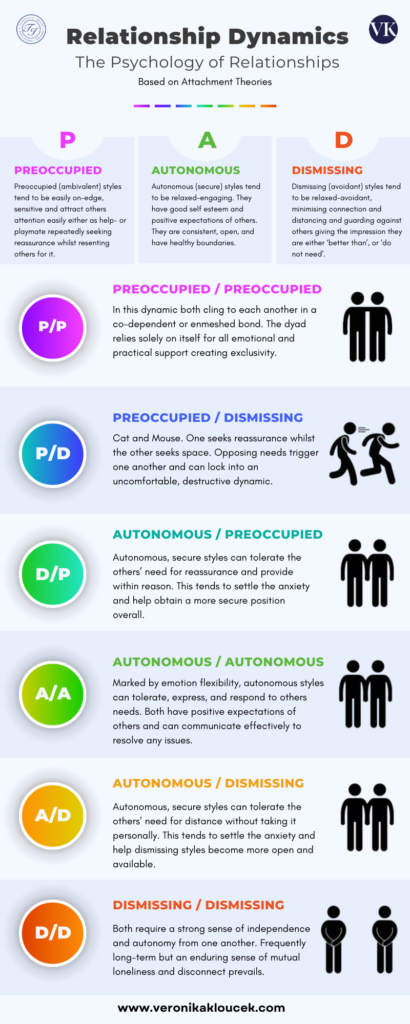
    Navigating interpersonal dynamics is an integral part of our daily existence, impacting us both in professional settings and within our personal lives. These dynamics are omnipresent, and while some individuals flourish in their relationships, others view interactions with people as a precarious endeavour.

    What factors contribute to healthy relationship dynamics, enabling some individuals to thrive, while leaving others feeling they merely endure interpersonal connections?


    Attachment Theory

    Attachment theory has been instrumental in understanding the dynamics of human relationships and how early experiences shape our personality. Its principles are equally relevant and illuminating when it comes to understanding interpersonal dynamics in corporate teams and personal relationships.

    How can the essential concepts of attachment theory be applied to improve teamwork, communication, and overall harmony in both professional and personal contexts?

    To learn more about the attachments styles matrix and the four primary styles read this article.


    Impact on Team Dynamics

    1. Recognising Attachment Styles:

    In a corporate setting, understanding the default attachment styles of team members, which tend to effect them most when stressed under pressure, can help leaders and colleagues work more effectively together. Identifying each team member’s attachment style can guide more effective communication and conflict resolution strategies.

    2. Creating a Secure Work Environment:

    Leaders can foster a secure work environment by providing consistent support, encouragement, and clear expectations. This can help employees with anxious or avoidant attachment styles feel more comfortable and engaged.

    3. Encouraging Collaboration:

    Autonomous (secure) team members tend to be emotionally flexible, thus more open to collaboration and constructive feedback. Encouraging collaboration can help create a more cohesive and productive team.

    4. Addressing Conflict:

    Conflict resolution strategies can be tailored to individuals’ attachment styles. For example, team members with a preoccupied (anxious) style may benefit from reassurance and validation, while those with a dismissing style may need space and independence to solve issues on their own and return with solutions.

    Impact on Personal Relationships

    1. Self-Awareness:

    Understanding your attachment style and that of your partner is essential for building a healthy personal relationship. It can help you recognise your own needs and those of your partner, fostering empathy and communication.

    2. Communication:

    Open and honest communication is key to any successful relationship. Knowing your attachment style can help you in finding words and ways to express your needs and fears more effectively and understand your partner’s perspective, how they reach out, and what they try to communicate to you.

    3. Embracing Vulnerability:

    Creating a safe space where both partners can share their feelings and concerns without fear of judgment is essential for a happy and healthy relationship. Emotional vulnerability means to share the bare pain, what really hurts. Vulnerability is not an explanation or justification. 

    An autonomous (secure) partner’s emotional flexibility encourages trust and emotional vulnerability. Partners with a preoccupied tendency can mistake vulnerability for letting their partner know all their feelings and be upset by their partner’s boundaries. Dismissing partners tend not keep their innermost feelings to themselves and be upset by their partner’s curiosity which they can experience as intrusive. 

    4. Seeking Professional Help:

    If attachment-related issues persist or lead to conflicts in personal relationships, seeking couples counselling can be highly beneficial. A trained therapist can offer a third perspective helping each partner where they miss the other and discover what they might be needing to work on themselves and together to develop healthier relationship dynamics.


    By taking action, you create a workplace culture and personal relationships that value and prioritise the mental and physical health of individuals leading to improved communication, enhanced collaboration, and greater overall well-being for everyone involved. 


    If this article resonates with you and you would like to find out more for yourself or your organisation about how we can help you increase your stress resilience and help prevent burnout, schedule a confidential enquiry call today!

    Veronika Kloucek, Senior Psychotherapist, Trainer, Coach